DataForSEO’s AI Optimization API is a group of endpoints for analyzing LLM visibility, generating model responses, and estimating AI-search demand.
Summarize with ChatGPTClaudePerplexity
View as Markdown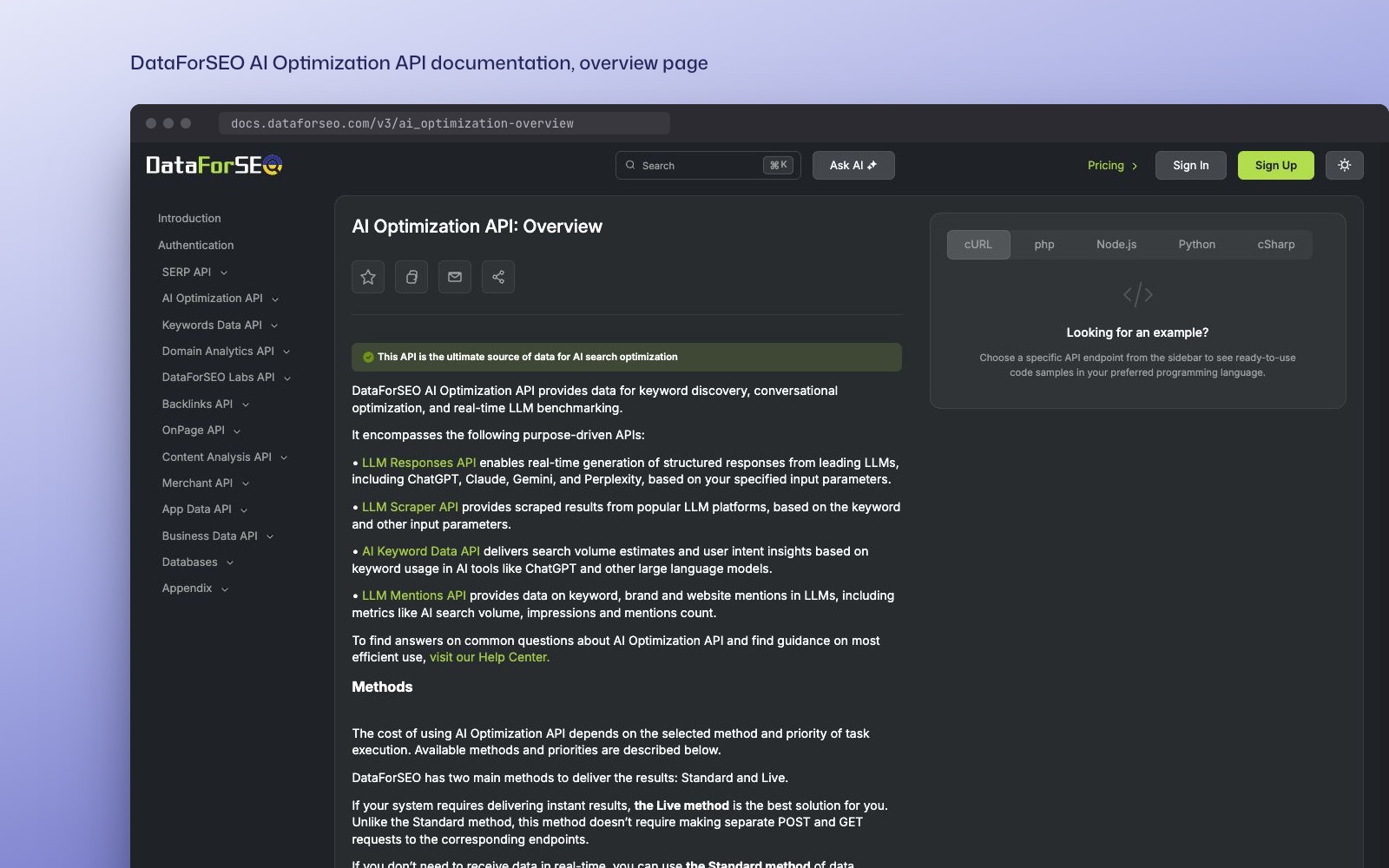
TL;DR
- DataForSEO’s AI Optimization API combines LLM Mentions, LLM Responses, AI Keyword Data, and LLM Scraper under one product family.[1]
- LLM Mentions provides search, target, multi-target, top-mentioned, historical, and time-series endpoints for analyzing visibility signals.[7]
- LLM Responses supports ChatGPT, Claude, Gemini, and Perplexity, with Standard and Live methods varying by platform.[2][10]
- AI Keyword Data reports estimated AI-search volume and a 12-month trend rather than a direct count of prompts from an AI platform.[3]
- Published pricing can combine task fees, row fees, and model-provider token charges, so production cost should be calculated from the exact endpoint and request volume.[13][4]
DataForSEO’s AI Optimization API is a group of endpoints for analyzing LLM visibility, generating model responses, and estimating AI-search demand. Its main product families are LLM Mentions, LLM Responses, AI Keyword Data, and LLM Scraper.[1]
For teams researching DataForSEO LLM mentions, the central distinction is straightforward: LLM Mentions measures how often keywords, brands, websites, and pages appear in LLM answers, while LLM Responses submits prompts to supported models and returns their answers.[2] AI Keyword Data adds estimated search-volume and trend data for queries used in AI tools.[3]
The API is best understood as an infrastructure layer rather than a complete content-optimization workflow. It can provide visibility measurements, response data, and demand estimates, but the available evidence does not establish that it exposes complete logs from every AI platform or a universally comparable metric across all models.[4]
What is the DataForSEO AI Optimization API?
DataForSEO groups its AI products under the AI Optimization Data API, with separate endpoint families for LLM Responses, LLM Mentions, AI Keyword Data, and LLM Scraper.[1] The product page presents these APIs as tools for monitoring and analyzing how brands, websites, and keywords appear in generative-engine results.[1]
The four families serve different technical purposes:
- LLM Mentions measures mentions, visibility signals, sources, and related AI-search metrics.[5]
- LLM Responses generates answers from supported LLM platforms for testing and comparison.[2]
- AI Keyword Data returns estimated AI-search volume and historical trends for keywords.[6]
- LLM Scraper is listed as a separate AI Optimization API family, although the cited documentation provides fewer endpoint details than the LLM Mentions and LLM Responses references.[4]
This separation matters when selecting an endpoint. A company measuring brand visibility needs LLM Mentions; a developer testing prompt outputs needs LLM Responses; and a researcher estimating conversational demand needs AI Keyword Data.[2][1]
Which DataForSEO endpoints are available?
The following table summarizes the endpoint families documented in the supplied research material.
| Endpoint family | Primary purpose | Delivery method | Main output or use |
|---|---|---|---|
| LLM Mentions | Measure keyword, brand, website, and page mentions in LLM answers | Live; Lite variants are also documented for selected reports | Mention metrics, top-mentioned entities, historical data, and time-series changes[7] |
| LLM Responses | Submit prompts and retrieve model-generated answers | Standard and Live for ChatGPT, Claude, and Gemini; Live for Perplexity | LLM answers, model information, token-use data, and possible web-search annotations[4] |
| AI Keyword Data | Estimate keyword demand in AI tools | Live | AI search volume and a 12-month trend[3] |
| LLM Scraper | Scrape results from LLM platforms | Standard and Live, depending on platform and endpoint | LLM result data; detailed endpoint coverage should be checked in current documentation[4] |
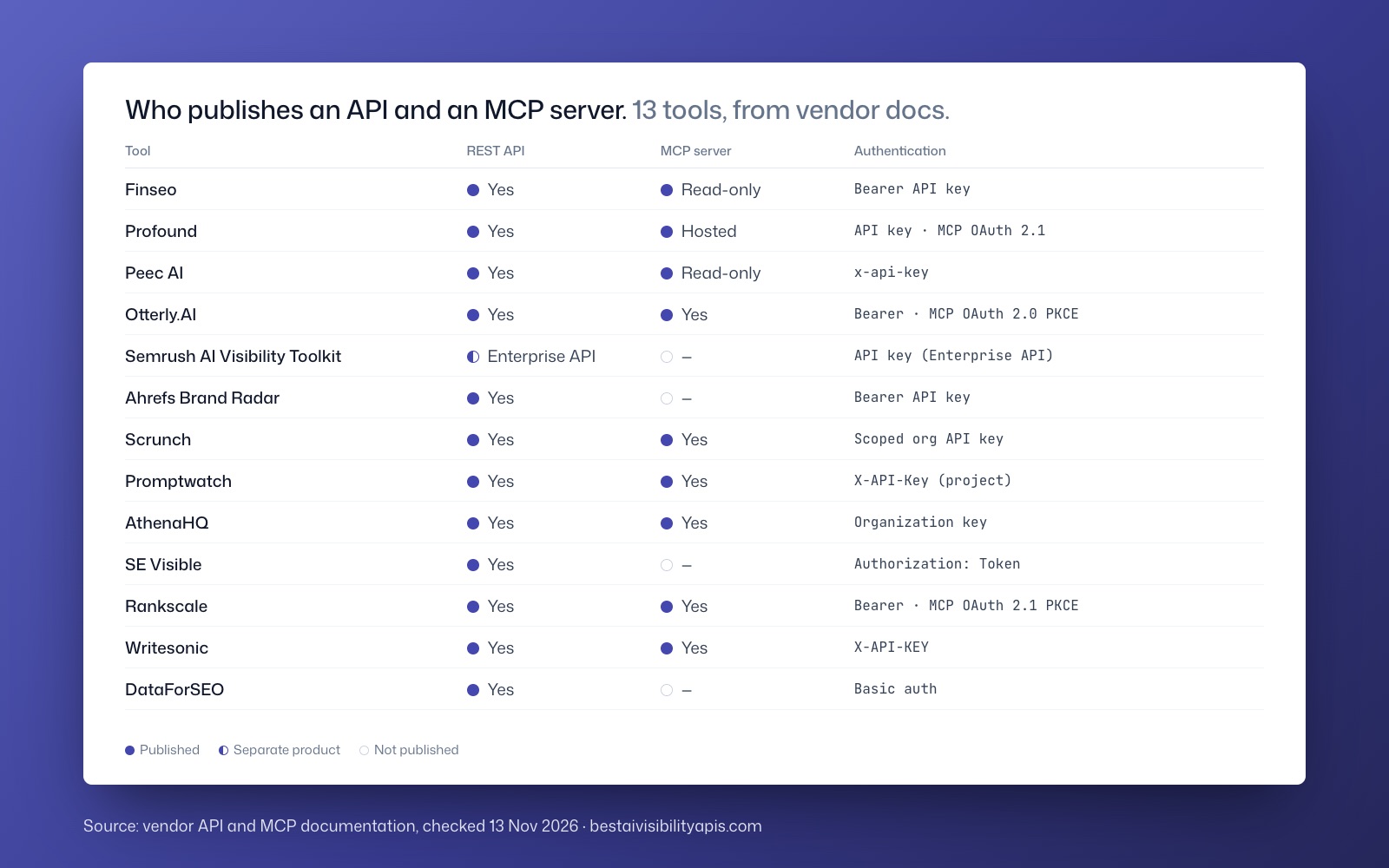
The API families do not share one delivery model. LLM Mentions and AI Keyword Data are documented as Live-only, while LLM Responses and LLM Scraper support Standard and Live methods depending on the platform.[1]
“Live” generally means that the request returns the result directly rather than requiring a separate task-submission and result-retrieval workflow. LLM Responses Standard uses separate task and result steps, while its Live method is the single-request option.[4]
What does the LLM Mentions API measure?
The LLM Mentions API is the main DataForSEO product for visibility analysis. Its documented endpoint set includes Search Mentions, Target Metrics, Multi-Target Metrics, Top Mentioned Pages, Top Mentioned Domains, Top Mentioned Brands, Top Mentioned Brand Categories, Historical data, Timeseries Delta, and Timeseries New & Lost.[7]
The endpoint family can be used to investigate questions such as:
- Is a brand mentioned for a target keyword?
- Which domains and pages appear most often in generated answers?
- How does one brand compare with several competitors?
- Which brands are gaining or losing visibility over time?
- Which categories or entities dominate answers for a topic?
The Target Metrics endpoint focuses on a target entity, while Multi-Target Metrics is intended for comparing multiple targets.[8] The release documentation describes a naming update from Aggregated Metrics to Target Metrics and from Cross Aggregated Metrics to Multi-Target Metrics, alongside new historical and Lite endpoints.[7]
The API overview describes LLM Mentions as covering mentions, sources, and AI search volume.[5] However, the supplied documentation does not identify a complete, fixed list of supported LLM platforms or model versions for these mention reports. That means users should verify engine coverage for their intended use case instead of assuming that every endpoint measures every major chatbot.[4]
LLM Mentions endpoint table
| Endpoint | Likely use | Availability |
|---|---|---|
| Search Mentions | Search for mentions associated with a query or target | Live[1][5] |
| Target Metrics | Analyze visibility metrics for one target | Live and Lite variants[7] |
| Multi-Target Metrics | Compare multiple brands, domains, or other targets | Live[8] |
| Top Mentioned Pages | Find pages frequently appearing in answers | Live and Lite variants[7] |
| Top Mentioned Domains | Find frequently cited or mentioned domains | Live and Lite variants[7] |
| Top Mentioned Brands | Rank brands appearing in generated answers | Live and Lite variants[7] |
| Top Mentioned Brand Categories | Analyze category-level brand visibility | Live and Lite variants[7] |
| Historical | Retrieve historical visibility data | Live |
| Timeseries Delta | Measure changes between periods | Live[9] |
| Timeseries New & Lost | Identify newly appearing or disappearing entities | Live[9] |
The exact request fields, response schema, authentication requirements, and pagination behavior should be taken from the current endpoint documentation before implementation.[4]
How do LLM Responses work?
LLM Responses is the answer-generation portion of the API. It allows developers to submit prompts to supported platforms and compare the resulting answers.[2]
The documented supported platforms are ChatGPT, Claude, Gemini, and Perplexity. ChatGPT, Claude, and Gemini support Standard and Live methods, while Perplexity is documented as Live-only.[10][1]
The Models endpoint allows users to select specific model versions for testing.[2] This is useful when response wording, citations, or visibility may differ between model versions. A comparison should therefore record the selected model rather than treating “ChatGPT” or “Gemini” as a single, permanently stable output source.
The ChatGPT Live endpoint accepts a user_prompt of up to 500 characters and uses model_name to select the model version.[4] If only a basic model name is supplied, the latest version is used by default.[4] An optional web_search setting can enable current web information, and the returned data can include model and token-use fields.[4]
Web-search annotations may contain source titles, URLs, and quoted text. They may be null when web search is disabled and may still be empty when web search is enabled.[4] Consequently, an empty annotation field should not automatically be interpreted as evidence that no web retrieval occurred.
Example request
The following illustrative request follows the documented field concepts for the ChatGPT Live endpoint. Developers should confirm the current authentication header, endpoint path, and complete schema in the live documentation before using it in production.[4]
curl -X POST "https://api.dataforseo.com/v3/ai_optimization/chat_gpt/llm_responses/live" \
  -u "$DATAFORSEO_LOGIN:$DATAFORSEO_PASSWORD" \
  -H "Content-Type: application/json" \
  -d '[
    {
      "user_prompt": "Which project management tools are best for remote teams?",
      "model_name": "gpt-4o",
      "web_search": true
    }
  ]'
A production integration should store the prompt, selected model, timestamp, response text, token-use fields, and any available web-search annotations. Retaining those fields makes it easier to compare outputs over time and distinguish changes caused by the prompt, model, or retrieval setting.[4]
What is AI Keyword Data?
AI Keyword Data estimates how frequently keywords are used in AI tools and provides a trend covering the previous 12 months.[3] Its documented live endpoint is AI Keyword Search Volume.[3][11]
The returned ai_search_volume value is not presented as a direct count of prompts logged by an AI platform. DataForSEO says the metric is estimated using statistical data from questions in the People Also Ask SERP element.[3] It should therefore be used as directional demand data rather than as a definitive measure of chatbot query volume.
This distinction is important for forecasting. An estimated AI-search-volume trend can help prioritize topics or compare relative demand, but it cannot by itself prove how many people asked a specific question in ChatGPT, Claude, Gemini, or another platform.[2][4]
The supplied documentation does not provide a complete supported-platform or model list for AI Keyword Data. Implementers should avoid describing the metric as platform-specific unless the current endpoint documentation confirms that detail.[4]
How is the API priced?
DataForSEO publishes separate prices for LLM Mentions, AI Keyword Search Volume, and LLM Responses. The pricing method depends on the endpoint and can combine a task fee with a row fee or model-provider usage charge.[3][12]
| API or method | Published processing timing | Published charge |
|---|---|---|
| LLM Mentions Live | Average turnaround of up to 2 seconds | $0.1 + $0.001, with the page also displaying $1,100 per 1M rows[12] |
| AI Keyword Search Volume Live | Average turnaround of up to 2 seconds | $0.01 + $0.0001, with the page also displaying $110 per 1M keywords[11] |
| LLM Responses Standard | Up to 72 hours | $0.0002 per task plus a $0.01 advance payment for LLM API costs[13] |
| LLM Responses Live | Average turnaround of up to 120 seconds | $0.0006 per task plus the selected LLM provider’s token charge[4] |
The LLM Responses price is not a single all-inclusive model rate. DataForSEO states that the provider charge depends on token processing, including input and output tokens.[13][4]
The LLM Mentions and AI Keyword pricing pages display both task-plus-row amounts and per-million figures.[1][7] For AI Keyword Search Volume, the supplied material does not explain how the per-task and per-row values relate mathematically to the per-million display. Buyers should confirm the billing calculation with DataForSEO before forecasting large-volume costs.[13][4]
What should be confirmed before production use?
Confirm the current endpoint path, authentication method, request limits, supported platforms, model names, response retention, rate limits, pagination, error behavior, and billing calculation. The supplied documentation establishes the main product families and published prices, but it does not establish every operational constraint for every endpoint.[1]
How should teams evaluate DataForSEO LLM mentions?
A practical evaluation should separate measurement quality from response-generation capability.
- Define the visibility object. Decide whether the project measures brand mentions, domain mentions, page mentions, competitors, categories, or all of these.[7]
- Create a stable prompt set. Keep prompts consistent enough to compare periods, while recording language, location, model, and retrieval settings where applicable.[4]
- Compare targets. Use Target Metrics for a single target and Multi-Target Metrics when comparing brands or domains.[7][8]
- Track changes over time. Use Historical, Timeseries Delta, and Timeseries New & Lost to identify movement rather than relying on one snapshot.[9]
- Separate estimates from observations. Treat AI search volume as an estimate, not as a direct platform query count.[1]
- Reconcile costs with output volume. Include task fees, row fees, and model-provider token charges where applicable.[13]
This approach also helps prevent a common analytical error: treating the answer returned by an LLM Responses endpoint as equivalent to a visibility measurement. A generated response shows what a model returned for a specific request, whereas LLM Mentions is designed to aggregate mention and visibility signals across the relevant data set.[4]
What are the main limitations?
The first limitation is coverage ambiguity. The LLM Mentions overview describes the available measurement functions but does not identify a complete list of supported LLM platforms or model versions in the supplied material.[4] Coverage should therefore be verified before comparing DataForSEO results with a first-party platform dashboard.
The second limitation concerns AI-search volume. The metric is estimated from statistical data associated with People Also Ask questions rather than directly reported by AI platforms.[3] It can support prioritization, but it should not be presented as an audited count of user prompts.
The third limitation is pricing complexity. LLM Responses combines a DataForSEO task charge with the selected provider’s token cost, while other endpoints display task-and-row pricing alongside per-million figures.[4][13] A simple “price per answer” comparison may therefore be misleading unless the request size and model are held constant.
The fourth limitation is model volatility. The Models endpoint enables version selection, and the ChatGPT Live endpoint can default to the latest version when only a basic model name is provided.[4] Reproducible testing requires recording the actual model version used for each request.
When should a team use each endpoint family?
- Use LLM Mentions when the primary question is whether a brand, domain, page, or competitor appears in generated answers.[4]
- Use LLM Responses when the primary question is what a supported model says in response to a controlled prompt.[4]
- Use AI Keyword Data when the primary question is whether a topic has estimated demand in AI-oriented search behavior.[4]
- Use LLM Scraper when the required workflow depends on extracting LLM result data and the current documentation confirms the relevant platform and method.[4]
- Combine LLM Mentions and LLM Responses when a team needs both aggregated visibility signals and representative answer examples.[7][14]
The academic GEO paper provides broader context for why organizations measure visibility in generative-engine responses: it describes a framework for improving visibility and reports increases of up to 40% in its experiments.[14] That research does not validate DataForSEO’s endpoint coverage, pricing, or measurement accuracy. Finseo’s own replication of the GEO techniques found that lift is rank-dependent: the same edit moved a rank-5 page +115% and a rank-1 page −30%.
Frequently asked questions
What is the DataForSEO AI Optimization API?
The DataForSEO AI Optimization API is a group of APIs for LLM responses, LLM mentions, AI keyword data, and LLM scraping.[1] It is designed to help developers generate model answers, measure visibility signals, and estimate AI-search demand.
What does the DataForSEO LLM Mentions API measure?
LLM Mentions provides endpoints for searching mentions, analyzing target and multi-target metrics, finding top-mentioned pages, domains, brands, and categories, and reviewing historical or time-series changes.[7] The supplied documentation does not provide a complete list of supported LLM platforms or model versions, so coverage should be confirmed for a specific project.[4]
Which models does DataForSEO LLM Responses support?
The documented LLM Responses platforms are ChatGPT, Claude, Gemini, and Perplexity.[1] ChatGPT, Claude, and Gemini support Standard and Live methods, while Perplexity is documented as Live-only.[10][1]
How accurate is DataForSEO AI search volume?
DataForSEO presents AI search volume as an estimate rather than a direct count of prompts recorded by an AI platform.[1] The estimate uses statistical data from questions in the People Also Ask SERP element, so it is more appropriate for directional trend analysis than precise platform-level measurement.[3]
How much does the DataForSEO LLM Responses API cost?
The published Standard price is `$0.0002` per task plus a `$0.01` advance payment for LLM API costs.[13] The published Live price is `$0.0006` per task plus the selected provider’s token-processing charge, including input and output tokens.[4]
Does DataForSEO provide a Live LLM API method?
Yes. LLM Mentions and AI Keyword Data are documented as Live-only, while LLM Responses supports Live methods for the documented platforms.[1] Live requests are intended to return results directly rather than requiring the separate task and result steps used by the Standard workflow.[4]
Sources
- 1aioptimization/overview – DataForSEO API v.3docs.dataforseo.com
- 2aioptimization/llmresponses/overview – DataForSEO API v.3docs.dataforseo.com
- 3aioptimization/aikeyworddata/keywordssearchvolume/live – DataForSEO API v.3docs.dataforseo.com
- 4aioptimization/chatgpt/llmresponses/live – DataForSEO API v.3docs.dataforseo.com
- 5aioptimization/llmmentions/overview – DataForSEO API v.3docs.dataforseo.com
- 6aioptimization/aikeyworddata/overview – DataForSEO API v.3docs.dataforseo.com
- 7Extended LLM Mentions API Release – DataForSEOdataforseo.com
- 8aioptimization/llmmentions/multitargetmetrics/live – DataForSEO API v.3docs.dataforseo.com
- 9How AI search volume metrics work in the LLM Mentions Timeseries endpoints – DataForSEOdataforseo.com
- 10LLM Responses API – DataForSEOdataforseo.com
- 11AI Keyword Search Volume API – DataForSEOdataforseo.com
- 12LLM Mentions API – DataForSEOdataforseo.com
- 13How the price for using LLM Responses endpoints is calculated – DataForSEOdataforseo.com
- 14[2311.09735] GEO: Generative Engine Optimizationarxiv.org